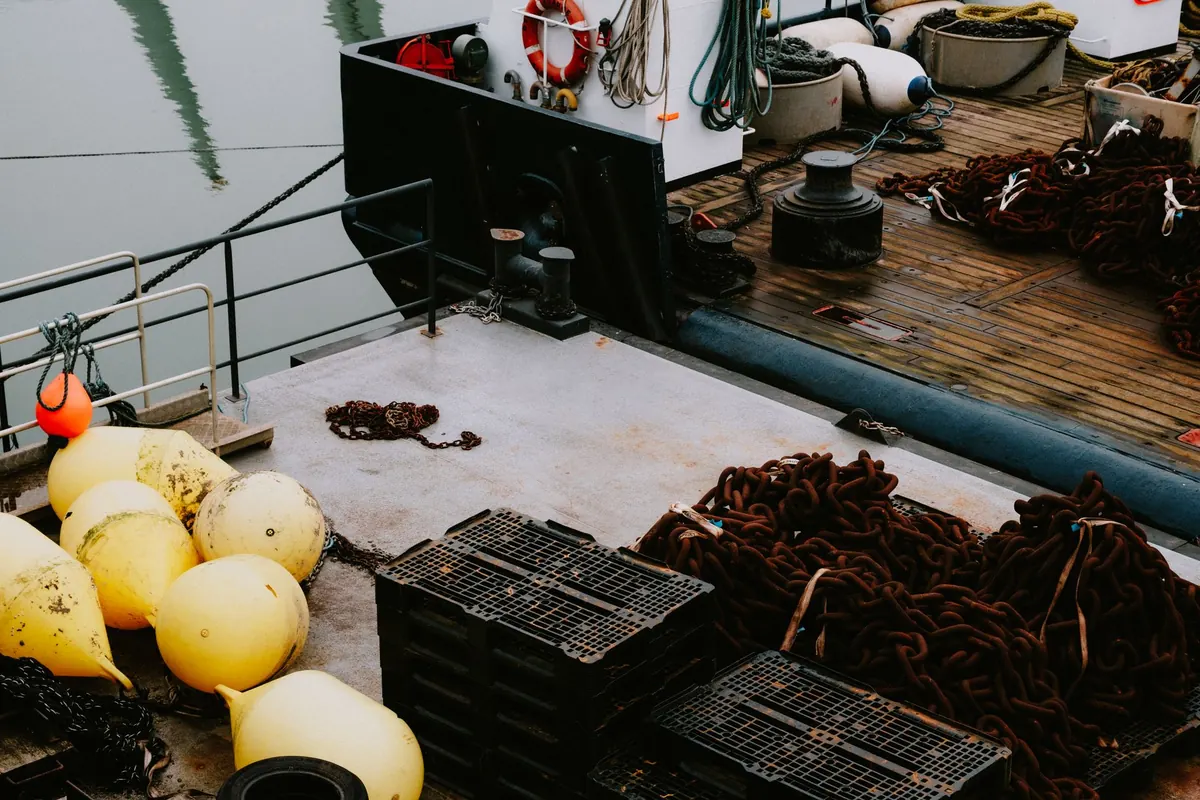
A mooring buoy looks simple from fifty metres away. A bright ball bobbing in flat water, waiting to be collected. Then you get closer, the bow pays off, someone leans over the rail with a boathook, and the whole thing becomes a small drama with an audience of neighbouring boats.
Picking up a mooring rewards a plan made ten minutes earlier. The goal never changes: arrive slowly, stop with the buoy within reach, and get a line through the ring before the boat drifts off. Everything below is about making that happen under power, under sail, and with fewer hands than you would like.
Do the preparation while the buoy is still small in the distance. Once you are inside two boat lengths, you should be driving, not rummaging.
Then brief the crew by name, not by role. "Sam points, I drive, you take the boathook." Agree on four words and what they mean: ready, buoy, away, abort. Anyone can call abort, and nobody argues about it.
If you intend to use the engine, start it early. Run it in neutral, confirm it will idle slowly, and check it goes into gear without a lurch. An engine that has not run since last weekend is not a plan.
Buoys lie to wind and tide, not to your convenience. Look at the boats already moored: their bows all point roughly the same way, and that is the direction the load will take. If everyone is lying to a fresh northeasterly despite a running tide, that tells you which force is winning today.
Decide which end of your boat you want the buoy on before you commit. In light air with no current, that is the bow, arriving head to wind. With a knot or two of tide running across the wind, plan to crab: aim upwind and upstream of the buoy so the two pushes cancel as you arrive. In shallow fields, also check the tidal curve. Some moorings dry out, and the riser chain can be bar-tight at low water even when the buoy floats.
Slow is the whole technique. If you think you are going slowly enough, you are probably still a little fast.
Sailing on and off a mooring is worth learning, and in a light, sheltered field it is often calmer than fighting an engine. Two principles make it work: use one sail, and always know your escape.
Main only, with the sheet eased, is the easiest rig. You can spill wind to slow down, the sail drops quickly, and there is no headsail flogging over the foredeck. A furling jib rolled away is the next best option. A hanked jib that has to come down in a hurry is the worst.
Approach on a reach or close reach so you can trim to control speed, and arrive with the sail luffing and the boat barely moving. If it is going wrong — too fast, wrong angle, another boat in the way — bear away and sail off. Going round again costs five minutes.
A second method suits shorthanded crews: heave-to two or three boat lengths to windward of the buoy and let the boat drift down onto it, using the backed jib and a touch of mainsheet to steer the drift. It is slow, it is quiet, and it gives you both hands free. Keep everyone behind the shrouds while the boom is moving.
Pick-up lines and pennants live in salt and ultraviolet light. Treat one as a handle, not as your mooring. If it looks furry, feels stiff, or is bleached pale, use your own line instead.
Pass the line through the ring so both ends come back to the boat. Take both to the same bow cleat. When you leave, you release one end and pull the other, and you never have to send anyone forward onto a bouncing deck. Then add a second line through the ring on a slightly different lead. Redundancy costs a minute.
An all-rope line with a bit of stretch is kinder than chain or wire. Where the line passes through the ring, fit chafe gear and check it after the first hour, then again after any wind. Keep the lines short enough that the boat cannot range far, but not so short that they snatch tight.
Look at the buoy's own gear before you relax. The swivel, shackle and chain tell you whether you want to stay. Rust-stained line, a missing mousing, or a shackle that is half undone are reasons to move on and anchor somewhere else.
Take a bearing or drop a mark on the plotter so you can tell instantly if you have dragged. Check the tide range for the night — will you dry out, or swing into shallower water than you thought? Look at the boats either side and estimate your swing circles. Then switch off the engine, secure the key, glance at the bilge, and read the forecast once more.
Finally, write down where you are and when you expect to move. A mooring pickup done well is invisible. The best compliment you will get is a neighbour who never looks up.
Photo: Mathias Reding / Pexels

A practical checklist for cross-border coastal cruising: the documents to carry, the safety gear officials ask...

Winter liveaboard life in Atlantic harbours rewards planning: read the marina contract, judge how the berth faces...

A practical guide to the unwritten social and operational rules of marina life, from handling lines and noise to...

Navigate the world's harbours with confidence..
