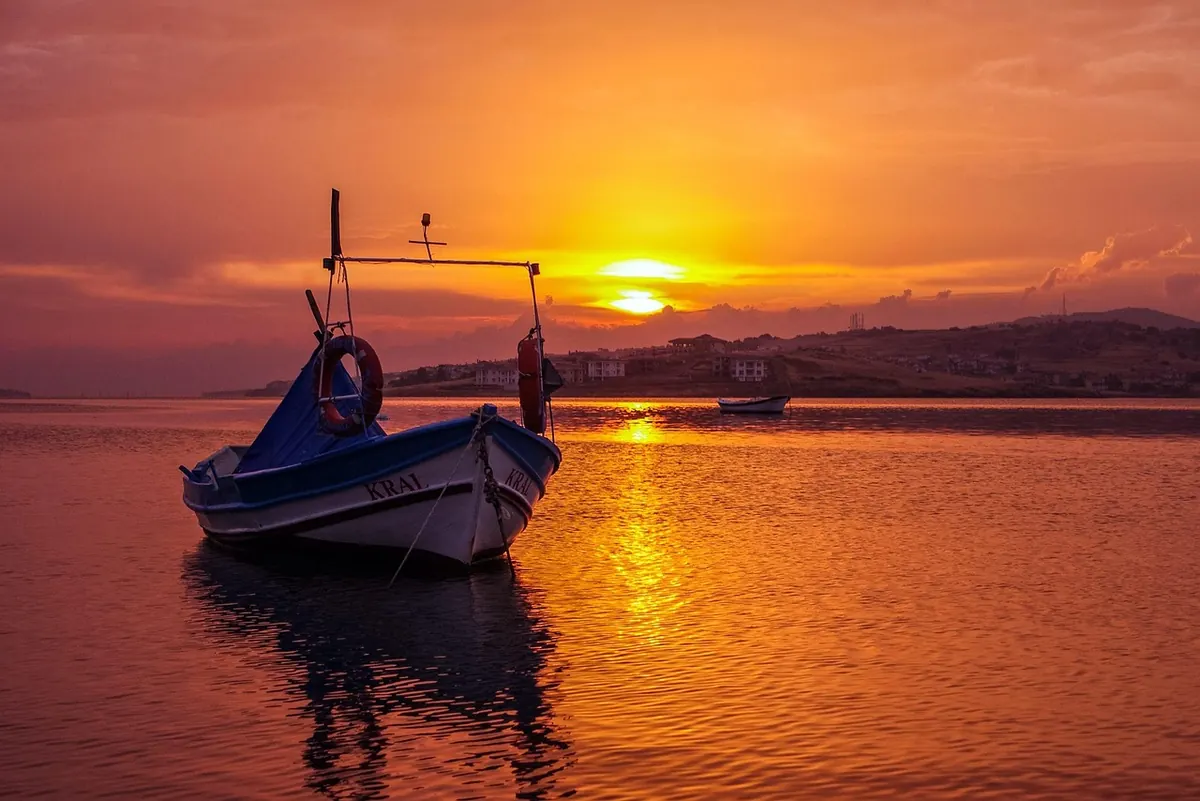
Drop the hook in a busy bay on a summer Saturday and you will see both ends of the spectrum. One skipper settles into a gap that looks barely wide enough, backs down, and sleeps through the night. Another drifts through the fleet at dusk with the engine running and a rope trailing astern. The difference is rarely luck; it comes down to a handful of decisions made in the ten minutes before and after the anchor touches bottom. These are the six mistakes that cause most of the trouble.
A boat lying to a single anchor sweeps a circle that starts at the anchor and runs out the length of rode plus the length of the hull. In 8 metres of water with 40 metres of chain out and a 12-metre boat, that is a radius of about 50 metres — a hundred metres across, and you own all of it. Arriving boats rarely picture that, which is how three crews end up sharing the space of one.
Watch the fleet before you commit. If every bow points the same way, wind and current agree and the circles stay tidy. If boats lie at odd angles to one another, something has just changed — a tide turn, a squall line, a shift in the breeze — and the circles are already overlapping.
Scope is the one thing you should not trade for a prettier spot. As a working rule, all-chain wants at least five times the depth in settled weather, and more when wind is forecast; rope or rope-and-chain rode wants more again. Measure depth from the bow roller, not the waterline, and add the tide still to come.
Three-to-one is a lunch stop, not an overnight one. If you can only fit by cutting your scope, the anchorage is full. Move, or look for shallower water, where the same ratio uses less chain and your swing circle shrinks with it.
A properly set anchor feels different from a dragging one: steady strain on the chain, no juddering, no slow creep of the transits.
You set the anchor in the water you had, not the water you will have. Tides, wind shifts, squalls and reversing currents all change the picture, and a crowded bay has no slack in it for surprises. Take bearings on two fixed objects and write them down — a house corner, a beacon, a tree that stands out. Note the depth and the highest tide expected overnight. A two-metre rise turns a comfortable five-to-one into something much less comfortable, and a shift of fifty degrees can put a neighbour's stern where your bow was.
Set an anchor alarm with a radius that allows for GPS scatter as well as genuine wander, and check that it works before dark rather than at the moment you need it.
The last boat in carries the burden of keeping clear. Do not drop inside another boat's swing circle, and do not assume the space between two anchored boats is free — they often lie further apart than their chains suggest. If you want to tuck in close, go and ask. Most skippers will happily tell you how much chain they have out, where their anchor lies and which way they expect to swing. A VHF call is fine, but plenty of boats anchored for the night are not listening; a dinghy and a polite hello settles it faster.
Small courtesies matter more in a tight bay than anywhere else. Run the engine only as long as you need it, keep the tender wake low when passing through the fleet, and if you plan to lie to two anchors, remember that you have fixed your orientation while everyone else has to allow for it.
Twenty minutes of watching is the cheapest insurance in the anchorage. Sit with a cup of tea and keep an eye on the transits through a tide turn if you can. If you do start to drag, act early: start the engine, ease the load off the chain by motoring gently ahead, then either let the anchor reset or haul up and start again somewhere with more room. Shouting at the neighbouring boat is not a plan.
If a squall or a strong shift is forecast, stay aboard, or move to a mooring or marina for the night. An unattended boat in a crowded anchorage becomes everyone else's problem, and it will be the boat downwind that pays for it.
Good anchoring in company is mostly a habit of looking before you commit and checking after you stop. Before you drop: read the fleet, note your neighbours, allow for the deepest water of the night, and pick a spot where your circle genuinely fits. After you drop: set the anchor under power, take bearings, set the alarm, and watch for twenty minutes. Before you sleep: check the forecast, the transits and the anchor light, and look at the boats around you one more time.
If something feels wrong, move while it is still light and calm. Re-anchoring after dinner is a mild inconvenience. Re-anchoring at two in the morning in a squall, with someone else's bow heading for your topsides, is what the other six mistakes were building towards.
Photo: ipala / Pixabay

A practical checklist for cross-border coastal cruising: the documents to carry, the safety gear officials ask...
Winter liveaboard life in Atlantic harbours rewards planning: read the marina contract, judge how the berth faces...
A practical guide to picking up a mooring buoy under power or sail, with approach plans, line handling, and safety...


Navigate the world's harbours with confidence..
